
“We stitch together quilts of meaning to keep us warm and safe, with whatever patches of beauty and utility we have on hand.” ― Anne Lamott
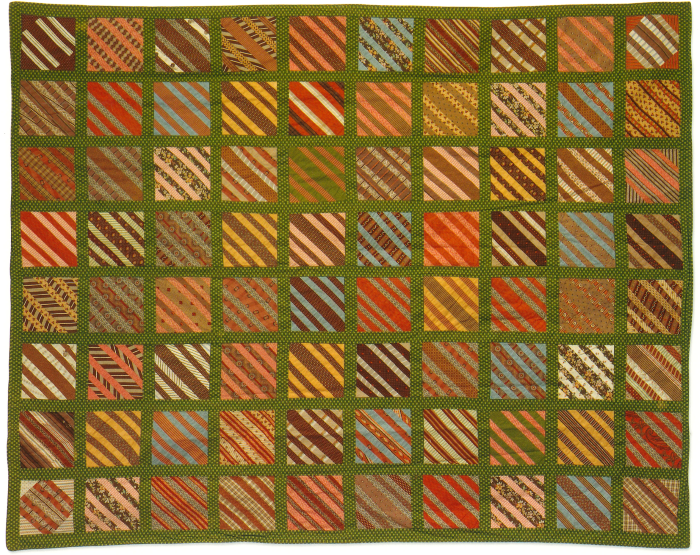
Squares and Diagonal Stripes
Pieced Quilt
Second half of the 19th century
Gift of Floyd King, Jr.
This handsome textile is technically not a quilt, as there is no middle layer. It was most probably intended as a bed cover or coverlet. It is in excellent condition and shows no sign of having ever been used. A strong green printed cotton cut into bands, or sashing, outlines a bold grid pattern. The grid consists of eighty squares each filled with eleven diagonal stripes of printed cottons in contrasting colors with alternating shades of light and dark. The central diagonal stripe in each square is wider than the others, and there are occasional variations of the fabrics within each square. The pattern is subtly changed in three of the four corner squares. It is an unusual and vigorous quilt design, with a lively and very modern feel to it.
The donor’s family has a long history in Oysterponds. His grandfather was Cicero Breese King who was a merchant with a store at the foot of the wharf. He lived in the green and red painted house at the southeast corner of Village Lane and Fletcher Street.
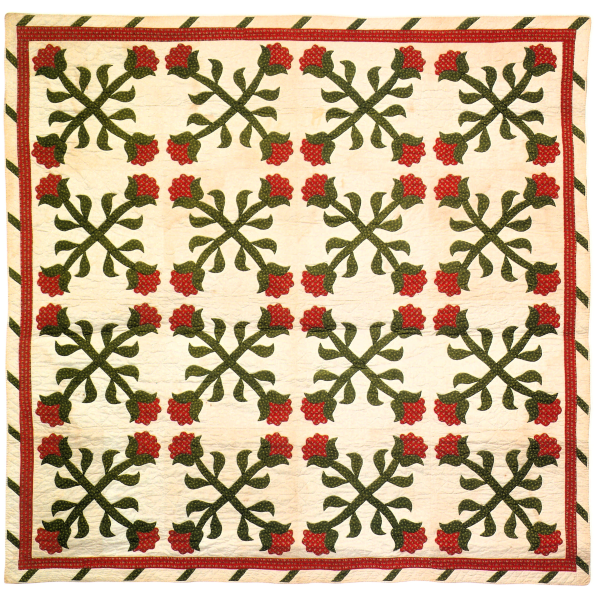
Tulip Quilt
Applique Quilt
Made by Frances C. Tuthill
Second half of the 19th century
This square quilt is one of a very few appliqued quilts in the collection. Applique quilts have design motifs that are cut out of various fabrics and sewn, or “appliqued,” to a cloth ground. The cloth ground itself may be a single piece of fabric or blocks of fabric which are sewn together to form the complete top. Floral motifs are characteristic of such quilts. In the 19th century these floral motifs were often highly stylized, and the most popular color combination was red and green on a white ground. This tulip quilt, with all these elements present, is a fine example of the type.
Each large crossed tulip pattern has been appliqued to a white cotton block; these were sewn together to form the square top layer made up of 16 blocks. The stitching throughout is very accomplished; carefully quilted circles and rosettes in the white areas constitute an integral part of the overall design. Quilting stitches also follow the applique design; these “in the ditch” stitches are less visible, but they eliminate the need to quilt over the applique pieces. The white cotton blocks in this quilt are themselves made from various pieces of white fabric sewn together to form a complete square – an example of a frugal woman using every scrap of material, wasting nothing. The maker of this quilt was born in Orient in 1836, married Oscar Tuthill in 1861, and died in Orient in 1904 at the age of 68.
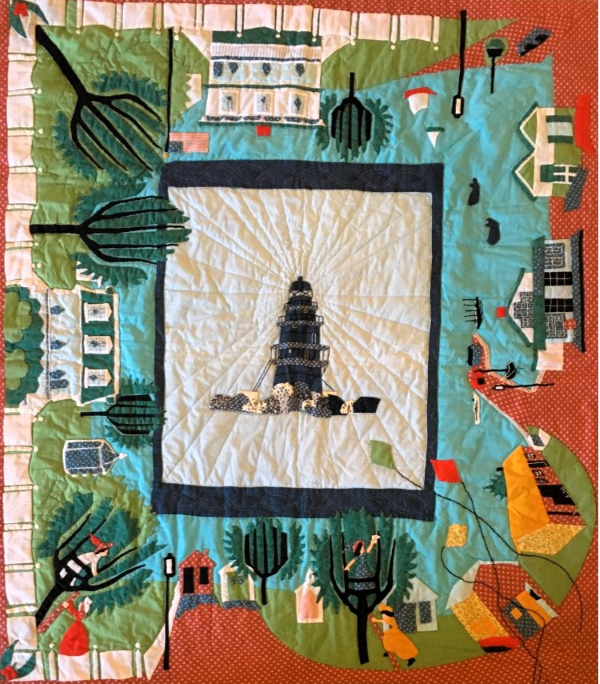
Orient 1900
Applique Quilt
Made by Hilda Mollineaux
1985
Gift of Elizabeth Mollineaux Cook
This is the largest quilt in the OHS collection and relatively new. The title is based on Rosalind Heitzman’s series of eight large panels on board titled “Orient – ca. 1900” in the OHS collection. The large central image is a familiar one – the lighthouse at Orient Point, often known as the “coffee pot”. The quilter, Hilda Mollineaux, lived in a house with a view of the lighthouse. In 1982, just three years before this quilt was made, Rosalind Heitzman painted her lively panels of life in Orient at the turn of the last century. All the vignettes surrounding the central image here are based on the Heitzman panels. Rosalind was the wife of the minister at the Congregational Church and the two women were great friends.
The donor is the granddaughter of Hilda Mollineaux. Hilda and her husband retired to Orient Point in 1978 where she became active in the local community including sewing with a local quilting group.
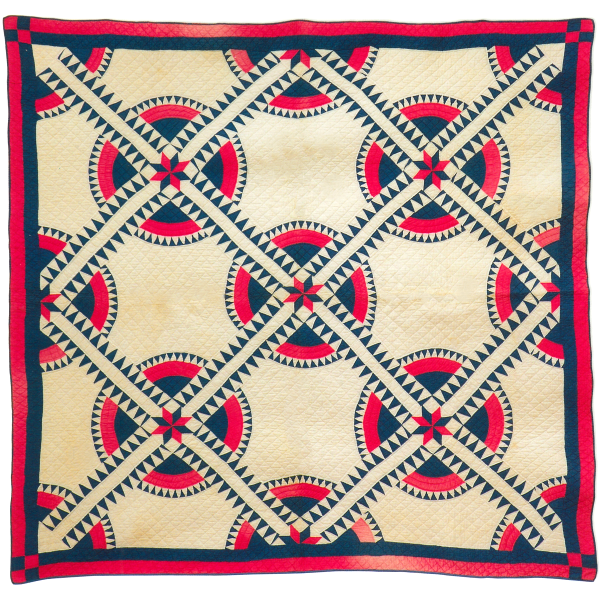
New York Beauty
Pieced Quilt
Second half of the 19th century
Gift of Mrs. Ernest Renard
This striking pattern, known as New York Beauty, is fairly rare – even in New York State where a quilt survey made in the 1980s and 1990s turned up relatively few examples. The origin and history of this pattern remain unknown. Its relative rarity probably stems from the fact that it is considered a particularly difficult pattern to make. An accomplished quilter is required to accurately sew the hundreds of tiny triangles. This pattern is sometimes called Crown of Thorns. The eight-pointed star at the center of each divided circle where the overlaying bands cross is called a Lemoyne Star and is based on a single diamond creating each point of the star. The dominant stitching in the quilt is known as crosshatch or grid quilting. This brightly colored New York Beauty quilt is in remarkably good condition.
The donor was Helen Storey Renard. Her mother, Alice Storey, was from Troy, New York, but the family summered in Orient. A New York State provenance for this quilt is therefore likely but not certain.
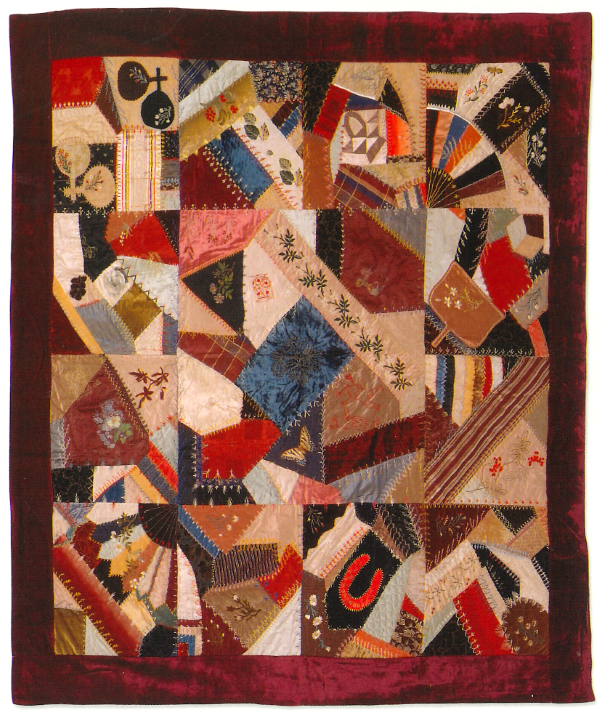
Crazy Quilt
Pierced and embroidered quilt
1880s
Gift of Alma Vail Knox and Clarence Vail
The vogue for fancy crazy quilts reached its zenith in the 1880s, coinciding with the aesthetic movement that swept through Europe and America at that time. A crazy quilt normally consists of numerous irregularly-shaped fabrics sewn together in an intentionally haphazard fashion. As virtually any sort of scrap could be used, crazy quilts were most likely the earliest American quilts, but few early ones survive. The familiar ones today are late Victorian crazy quilts that made use of a variety of luxurious fabrics such as silks, velvets, and satins. Such quilts were usually, as here, embellished with extravagant embroidery in fanciful designs and inventive stitches.
In this quilt the haphazard shapes are confined within a square. There are twenty squares in all, attached to one another with embroidery stitches. Within each square there are colorful bits of fabric – with up to thirty-five or more different pieces in each square. Silk embroidery stitches cover the seams. Each square is enlivened with embroidered designs of rings, moths, flowers, a Japanese fan and even an umbrella design which is appliqued and then embroidered. The many-colored silks and velvets are plain, striped, plaid, or patterned. The twenty blocks are surrounded by a border of alternating triangles and cones which result in a graceful scalloped edge to the quilt. There are condition problems with some of the fabrics, particularly those in the border.
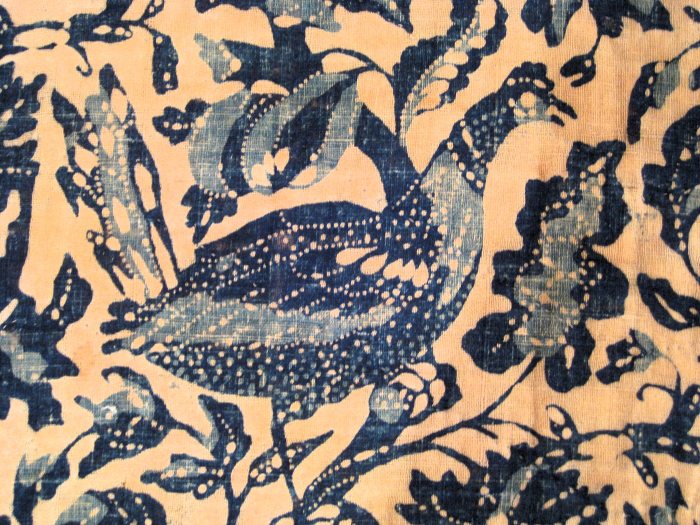
Blue Resist Quilt (detail)
Maker unknown. Linen, c. 1790.
This wholecloth quilt dating from the late eighteenth century is a remarkable survival. The blue dye is indigo and the overall design is achieved by a technique called resist printing. Fabrics with a blue pattern on a white background are far less common than white designs on an indigo background. Both would have been very labor-intensive to produce and therefore very costly. Found mostly in America, they are generally referred to as “American blue resist,” but textile historians have yet to discover exactly where and how these extraordinary fabrics were made. The quilt was the gift of Frances Martin. It had been purchased from the estate of Benjamin Dwight Latham of Orient Point. Many Latham families still live in Orient.
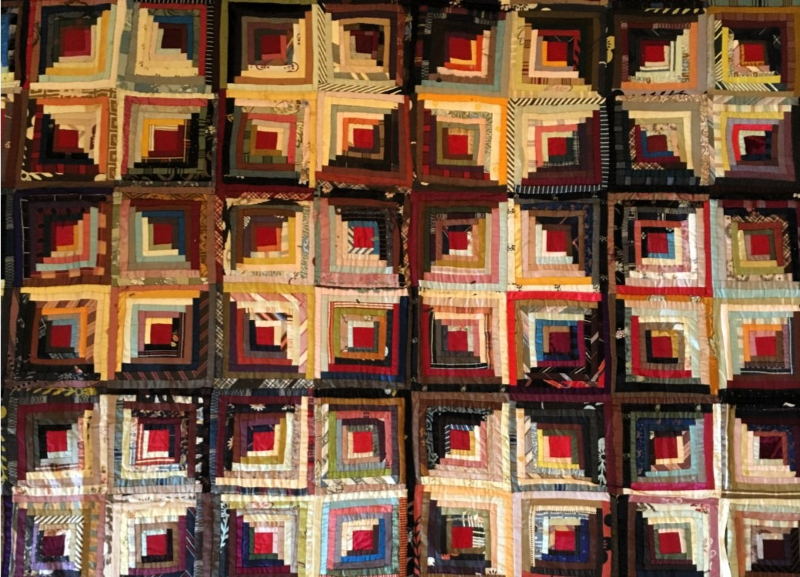
Log Cabin – Light and Dark Variation
Pieced Quilt
Made by Mary Jane Stevenson Younie
Second half of the 19th century
Gift of Priscilla Bull
This quilt was made by Priscilla Bull’s great grandmother and we are grateful that she graced OHS with its donation. Log Cabin, with its many variations, is perhaps the best-known and most easily-recognizable of all block patterns. It is said that the pattern was so popular in the late 19th century that it had its own category in quilt contests at State Fairs. Each block begins with a foundation fabric onto which the central square and all the strips are sewn. The central square is usually red (perhaps representing the fireplace), but can be yellow or black. In this case the central squares are red or purple. The strips are sewn outward from the central square until the block is complete. Light-colored silks are used on half of the block and dark fabrics on the other half. Different patterns can be achieved depending on how the blocks are arranged. In this variation, known as Light & Dark, there is an alternating pattern of light and dark diamonds, as each square is set on point.
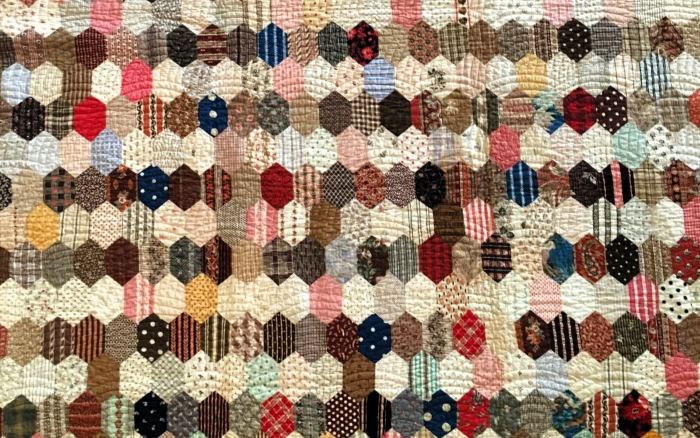
Hexagon
Pieced Quilt
Second half of the 19th century
Gift of Mrs. L.A. Van Kleeck
This deceptively simple quilt design is made of a great many connected, elongated hexagons. They are arranged vertically in alternating rows of light and dark fabrics which gives some structure to what otherwise seems a random design. Hexagons, a form often used in quilt making, are usually of a more regular shape and arranged to create a specific design. They are the basic units of quilts known as Honeycomb, Grandmother’s Flower Garden, and Mosaic. The piecing in this quilt involves a great variety of 19th-century printed cotton fabrics. Women kept scrap bags full of every bit of material that could be saved and recycled. Fabrics are frequently useful for dating quilts – but scrap bags could be used for years and even handed down from generation to generation. Fabrics are therefore not always an accurate guide to dating a quilt.
The quilting, or stitching, in this quilt is interesting because it is in a pattern completely unrelated to the piecing of the hexagonal shaped cottons. The quilting creates its own overall design in what is known as a clamshell pattern.
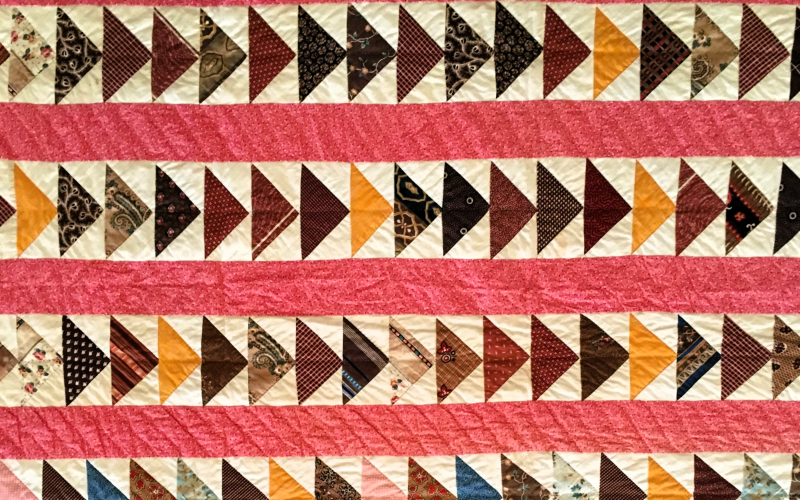
Flying Geese
Pieced Quilt
Second half of the 19th century
Gift of Floyd King, Jr.
The Flying Geese pattern features rows of triangles all set in the same direction suggesting a flight of geese. It is a popular quilt pattern and one with many variations. This pattern consists of triangles of varied printed cottons carefully arranged in vertical lines. They run parallel to the edge of the quilt, separated by vertical stripes of a single fabric. This is one of the most common variations of the pattern. The quilt is very neatly pieced and quilted and makes use of a wide variety of lovely 19th century printed cottons. It is in excellent condition.
The donor’s father was Floyd King, Sr. who owned and ran the Bay House, a hotel located at the foot of the wharf in Orient. King, Sr. married twice. His second wife was Belle Dickerson from Shelter Island. This quilt (and several others in the OHS collection) were originally hers and may well have been made on Shelter Island by a member of Belle’s family.
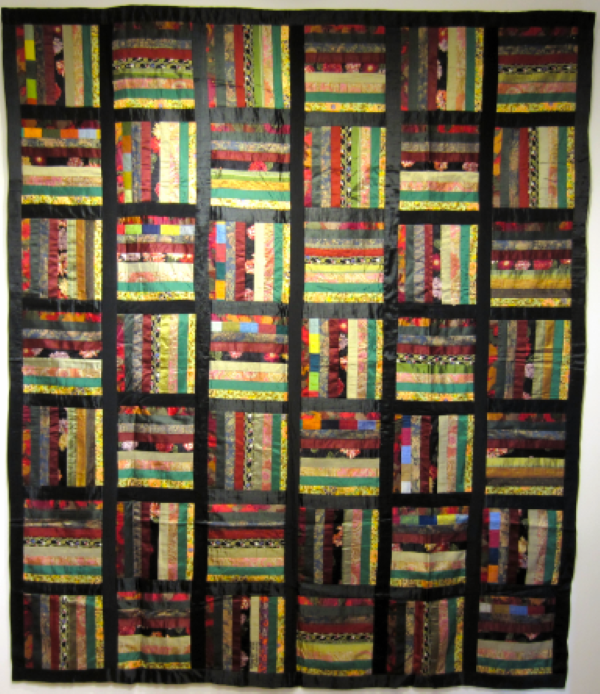
OHS’s first 21st-century Oysterponds quilt