
OHS’s buildings and the exhibitions therein are closed for the season. Staff may be available M-F throughout the year to open the doors and give tours. If interested, please call the office at 631-323-2480 for more information. Please note that admission charge is $10 per Non-member Adult.
Click here for info regarding becoming a member.
LOST OYSTERPONDS
The photographs on view in this exhibition depict buildings that were once an integral part of the built environment of East Marion and Orient. These photographs are our most important visual record of those buildings that have been lost. Some structures were purposely torn down, others lost to fire or hurricanes, others simply moved to other places – like the Orient Mill, a beloved structure that was sold and moved by barge to an amusement park where it burned to the ground a dozen years later.
CURLICUE WICKER
By the 1890s wicker furniture had become extraordinarily popular in America and ever more elaborate pieces were being produced. OHS is fortunate to have two pieces from the two most important wicker furniture manufacturers in America: a rocking chair made by The Wakefield Rattan Company, and a baby carriage made by Heywood Brothers & Co. Several other pieces have no maker’s labels, but they might have been made locally, as the Greenport Rattan Company was flourishing at that period.
CHILDREN’S VEHICLES
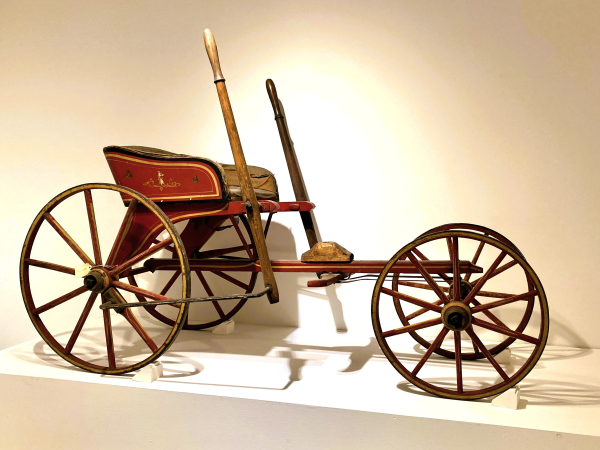
This exhibition is devoted to large toys: vehicles that children could ride in or on that could be self-propelled or pulled or pushed. An early tricycle and a painted sled are familiar to all, but a goat cart and an Irish Mail less so. A writer in the New Yorker some sixty years ago called the Irish Mail “the most wonderful four-wheeled vehicle for boys ever invented.” The goat cart was meant to pulled by the child’s pet goat, or dog, or pony – or perhaps a sibling.
RECENT ACQUISITIONS
The past few years have been exceptional for the quality of the objects being donated to OHS. Last year’s extraordinary portraits have been followed this year by three issues, dating from 1812 and 1813, of the exceptionally rare newspaper the Long-Island Star and our first quilt made in Oysterponds in the twenty-first century, as well as a model of an iceboat, a bust of Lincoln by Robert Berks, and the addition to our whaling collection of our first blubber fork.
ABRAHAM G. D. TUTHILL
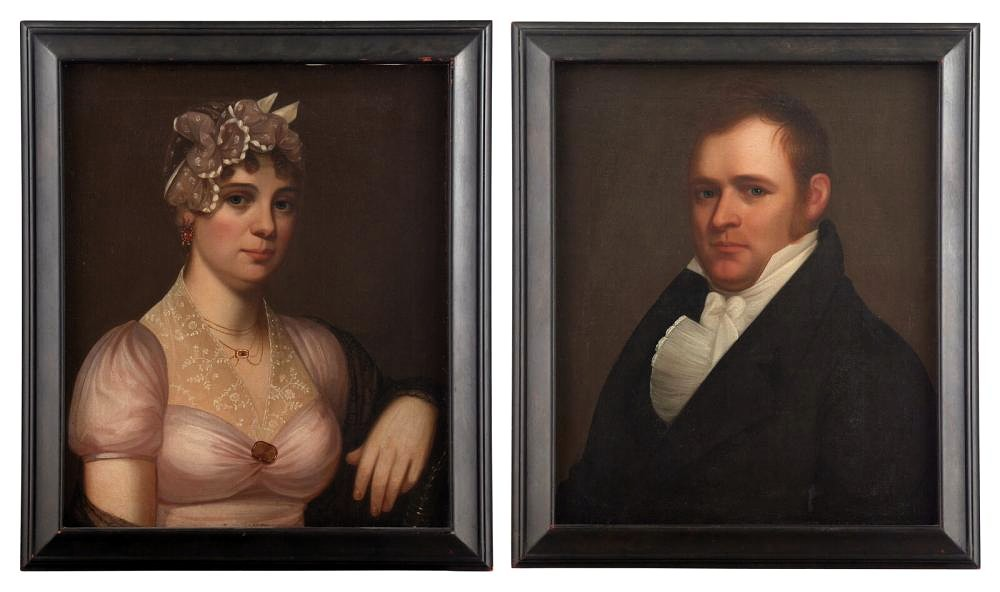
This exhibition celebrates the acquisition of two portraits painted by Abraham G.D. Tuthill, the only eighteenth-century artist born in Oysterponds. Tuthill studied in London with the American-born painter, Benjamin West, from about 1800 to 1808. After returning to America, he became an itinerant artist traveling as far as the mid-west, but eventually ending up in Vermont. We are fortunate to have in the OHS collection a portrait he painted just before going abroad, and another, painted here, just after his return. The handsome new portraits, of an unidentified man and woman (undoubtedly husband and wife), date from the later part of his career.
ROBERT BERKS: THE MARY McLEOD BETHUNE MEMORIAL
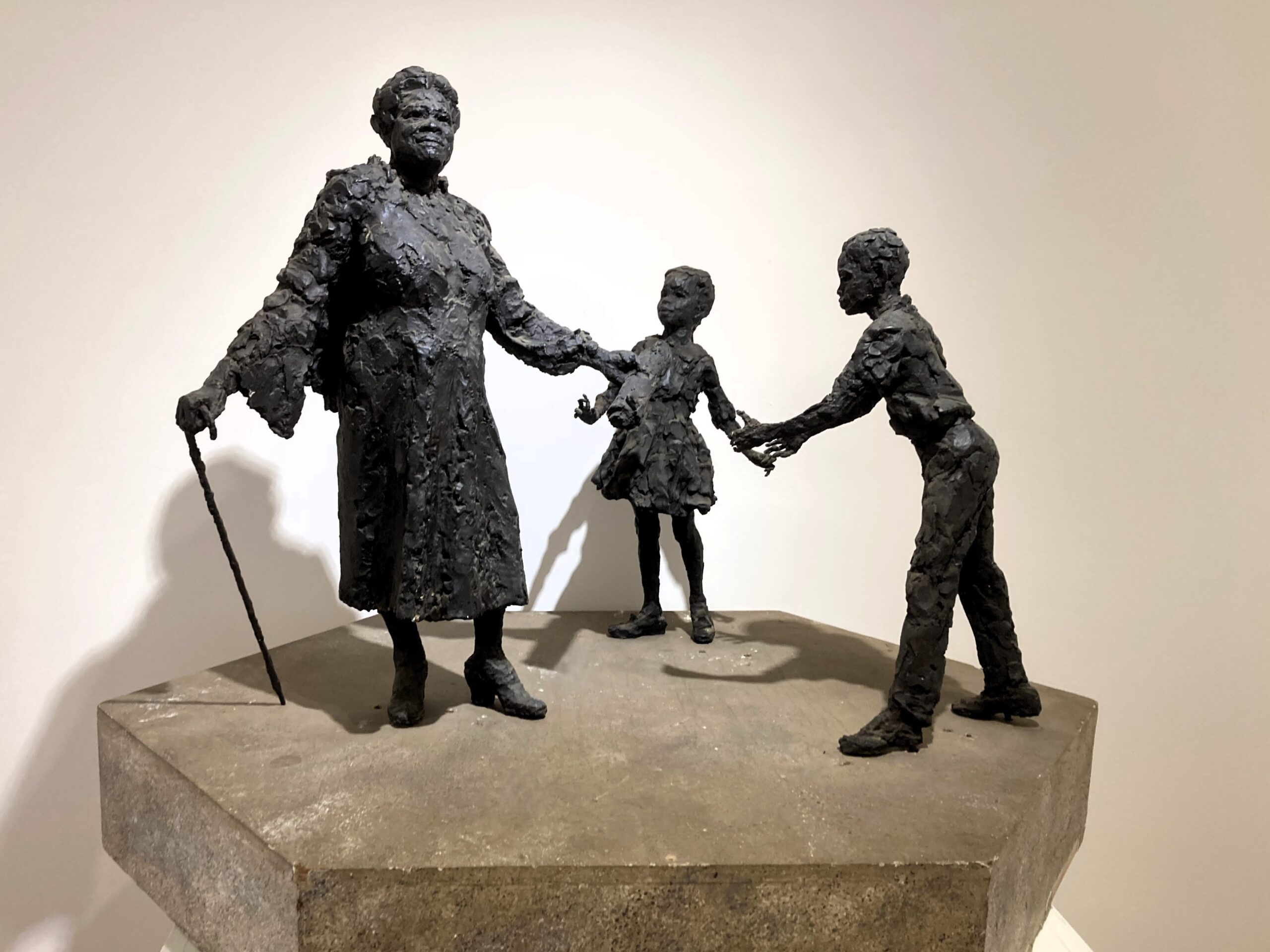
Robert Berks (1922-2011) who lived for many decades in Orient was a nationally-known sculptor who specialized in creating large-scale, monumental sculptures of major figures in American history. One of his most important commissions was the creation of a memorial to Mary McLeod Bethune (1875-1955) who was the founder in 1935 of the National Council of Negro Women, and became a world-renowned educator, civil rights leader, women’s rights activist and presidential advisor. Berks’s large-scale memorial to her was dedicated in Lincoln Park in Washington, D.C. in 1974. It was the first monument to an African-American, or to a woman, to be placed in a public park in the nation’s capital.
![IMG_0204[1]](https://oysterpondshistoricalsociety.org/wp-content/uploads/2026/03/IMG_02041.png)
![IMG_0205[1]](https://oysterpondshistoricalsociety.org/wp-content/uploads/2026/03/IMG_02051.png)
![IMG_0206[1]](https://oysterpondshistoricalsociety.org/wp-content/uploads/2026/03/IMG_02061.png)
![IMG_0207[1]](https://oysterpondshistoricalsociety.org/wp-content/uploads/2026/03/IMG_02071.png)
![IMG_0209[1]](https://oysterpondshistoricalsociety.org/wp-content/uploads/2026/03/IMG_02091.png)
![IMG_0210[1]](https://oysterpondshistoricalsociety.org/wp-content/uploads/2026/03/IMG_02101.png)
![IMG_0213[1]](https://oysterpondshistoricalsociety.org/wp-content/uploads/2026/03/IMG_02131.png)
![IMG_0215[1]](https://oysterpondshistoricalsociety.org/wp-content/uploads/2026/03/IMG_02151.png)
![IMG_0234[1]](https://oysterpondshistoricalsociety.org/wp-content/uploads/2026/03/IMG_02341.png)
![IMG_0218[1]](https://oysterpondshistoricalsociety.org/wp-content/uploads/2026/03/IMG_02181.png)
![IMG_0217[1]](https://oysterpondshistoricalsociety.org/wp-content/uploads/2026/03/IMG_02171.png)
![IMG_0223[1]](https://oysterpondshistoricalsociety.org/wp-content/uploads/2026/03/IMG_02231.png)
![IMG_0224[1]](https://oysterpondshistoricalsociety.org/wp-content/uploads/2026/03/IMG_02241.png)
![IMG_0225[1]](https://oysterpondshistoricalsociety.org/wp-content/uploads/2026/03/IMG_02251.png)
![IMG_0226[1]](https://oysterpondshistoricalsociety.org/wp-content/uploads/2026/04/IMG_02261.png)